 +662-105-4288
 1800 789 560



Full Mouth Implants vs All -on 4
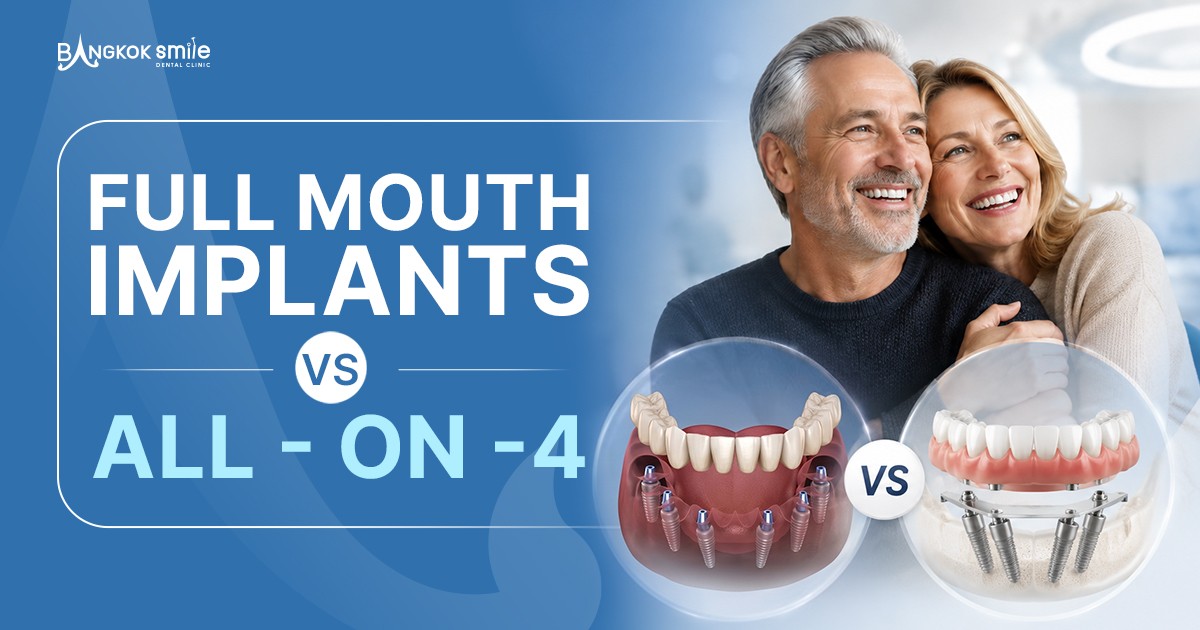
Comparing full mouth implants vs All-on-4? The confusing part is that "full mouth dentalimplants" doesn't actually mean one fixed procedure. To one person it means literally oneimplant for every missing tooth, eight or more per jaw. To another it means All-on-4 specifically.To a third it's a vague umbrella term for "fixing all my teeth with implants," with no clear pictureof how many implants that actually involves. Before any meaningful comparison can happen, it'sworth being precise about what each option actually proposes, because the differencesbetween them affect cost, healing time, and how the final result feels in your mouth.
What "Full Mouth Implants" Usually Means
In its traditional sense, full mouth implant treatment refers to placing a higher number ofimplants, often six to eight per arch, to support either an extensive fixed bridge or a full set ofindividual implant-supported crowns. The logic is straightforward: more implants distribute bitingforce across more points, which has historically been considered the safer approach forreplacing an entire arch of teeth.
This approach has real advantages in certain cases, particularly where bone volume is goodthroughout the jaw and a patient wants the closest possible simulation of natural teeth, withindividual implants in roughly the positions natural tooth roots once occupied. It also has realcosts. More implants means more surgical sites, longer total treatment time, and in patientswithout ideal bone volume, it frequently requires extensive bone grafting before any implantscan be placed at all, sometimes adding the betterpart of a year to the process before the finalteeth are ready.
What All-on-4 Specifically Proposes
All-on-4, developed by Dr. Paulo Maló and the protocol we follow as his exclusive partner clinicin Thailand, takes a different engineering approach to thesame goal. Rather than maximizingthe number of implant sites, it uses exactly four implants per arch, two placed vertically at thefront of the jaw where bone is typically best preserved, and two placed at an angle toward theback, reaching into denser bone further along the jaw while avoiding anatomical obstacles likethe sinus cavity or nerve canal that limit straight implant placement in patients with reduced bone.
These four implants support a full-arch fixed bridge, not individual crowns, and the angledpositioning of the posterior pair means the bridge can typically be loaded with a provisional setof teeth within around 24 hours of surgery, rather than requiring the months of healing typicallybuilt into traditional full mouth implant timelines before any teeth are attached
The Real Trade-Offs, Not the Marketing Version
Patients researching this topic often encounter content that presents All-on-4 as simply themodern, better version of full mouth implants in every case, which oversimplifies a genuinelycase-dependent decision. Here is a more honest breakdown of what actually differs.
- Number of implants and surgical sites. Four per arch with All-on-4 versus six to eight withtraditional full mouth approaches means fewer surgical sites, generally lesstotal surgical time,and a meaningfully lower implant cost, since cost scales closely with the number of implantsplaced.
- Bone requirements. This is where All-on-4 has its clearest advantage for the patients we seemost often. Because the protocol was specifically engineered around limited bone availability,many patients who are told they need extensive grafting before traditional full mouth implantscan qualify for All-on-4 with no grafting, or only a small, localized graft, because the implantpositionswere designed to work with reduced bone in the first place.
- Healing and timeline. All-on-4's fixed provisional bridge on day one is one of its most genuineadvantages for patients traveling internationally for treatment, since it means leaving the countrywith a functional, fixed set of teeth rather than weeks or months of having no teeth or relying ona temporary removable solution. Traditional full mouth implant treatment, particularly whengrafting is required first, often involves a staged process across multiple visits over manymonths.
- Feel and long-term maintenance. Some patients, particularly those with excellent bonevolume and a preference for individual implant-crowns over a connected bridge, may genuinelyprefer the traditional approach, since individual crowns can be maintained or replaced one at atime if an issue arises, whereas an All-on-4 bridge is typically managed and adjusted as aconnected unit. This is a legitimate consideration, not a marketing point in either direction, andit's partof why this decision benefits from an honest conversation rather than a one-size-fits-allrecommendation.
- Cost. Fewer implants and a faster overall timeline generally make All-on-4 the more cost-effective path for full-arch tooth replacement, which is onereason it has become the morecommonly recommended option for patients who are already edentulous or close to it.Traditional full mouth implant treatment with more implant sites and potential grafting carries acorrespondingly higher total cost.
How We Actually Decide Which Path Fits
The decision starts with the same 3D Cone Beam CT scan we use for every implant case,which shows bone volume and density in detail a standard X-ray cannot. From there, thequestions we're really answering are: does this patient have adequate bone for All-on-4'sspecific implant positions without grafting, would a small graft close that gap acceptably, or isbone volume actually good enough throughout the arch that a higher implant count is bothfeasible and potentially preferable for this particular patient's goals and budget.
For most patients who are already missing most or all of their teeth, or whose remaining teethare failing and need to be extracted, All-on-4 ends up being the more practical and cost-effective recommendation, and it's also the path with the strongest published outcome data behind it specifically: the ten-year study published in the Journal of the American DentalAssociation, covering 245 patients, reported a94.8% cumulative implant survival rateand a99.2% prosthetic success rate under the original Maló protocol. For a smaller group ofpatients, usually those with strong existing bone and specific preferences about how their finalteeth should feel and be maintained, a higher implant count remains a reasonable andsometimes preferable choice.
What This Means If You're Trying to Decide
If you're comparing these two paths based on articles or forum posts rather than your own scan,the honest answer is that neither option is objectively superior in every case; the right choicedepends heavily on your current bone volume, how many teeth you're replacing, your timeline,and your budget. What we'd recommend before committing to either is sending your mostrecent dental X-rays or scheduling a 3D scan with us, sothe comparison is based on youractual anatomy, not a generic description of either procedure. That single step usually narrowsthe decision down considerably, and in many cases makes it fairly clear which path genuinelyfits.
A Note on Mixed Cases
Not every patient fits neatly into one category or the other, and it's worth saying so plainly. Weoccasionally see cases where the upper jaw has good bone volume throughout, making ahigher implant count realistic there, while the lower jaw has experienced moresignificantresorption, making All-on-4's specific implant geometry the better fit for that arch alone. In thesesituations, the two jaws are sometimes planned differently rather than forcing a single approachonto both, and this is exactly the kind of nuance that gets lost in generic online comparisons butmatters a great deal once we're looking at an individual patient's actual scan. It's also why we'recautious about quoting a firm treatment plan before that imaging exists; a plan built onassumptions about both arches being similar can turn out to be wrong in either direction oncethe scan is reviewed. Click to Book Now